Seven Hundred Miles From a Lift: The Case for Road-Tripping Your Unfinished Build
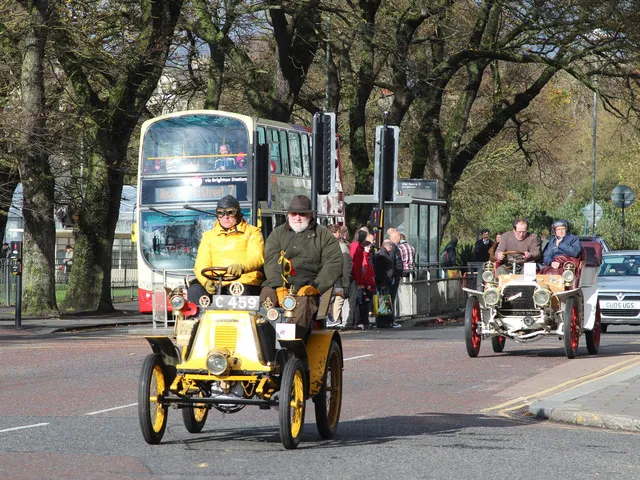
Photo: Oast House Archive , CC BY-SA 2.0, via Wikimedia Commons
Let me save you the suspense: your project car is not finished. It doesn't matter that the head gasket is done and the new exhaust sounds mean in the driveway. It is not finished, and it will not be finished, because project cars are never finished. So stop waiting for the mythical "done" day and do the thing that actually validates the build: drive it somewhere far.
I'm not talking about a 40-mile loop to the ice cream stand with a toolbox zip-tied in the trunk. I'm talking multi-day, multi-state, no-lift-in-sight, wife-kids-or-buddies-two-hundred-miles-away kind of driving. That's where a build proves itself — or doesn't.
Why the Shop Can't Teach You This
In your garage, every problem announces itself politely. The car is cold, you have tools, the internet is right there, and worst case, you push it three feet and wait until tomorrow.
On the road, problems introduce themselves differently. That subtle driveline shudder? It shows up at 72 mph, in a crosswind, outside Amarillo, and it gets worse when the transmission heats up. The carb tuning that seemed fine at sea level? Enjoy your elevation change through the Rockies. The cooling system that's "probably fine"? Desert traffic on I-10 in July has opinions.
A road trip is a shakedown test with stakes. Heat cycles, sustained load, fuel quality variation, vibration, elevation, weather — you can't simulate any of that with the car on jack stands. And here's the part nobody says out loud: the stress is the feature. When you know a breakdown means a tow from the middle of Nevada, you fix the sketchy stuff instead of deferring it. The trip forces honesty into the build.
The Spares Kit: Pack Like a Fatalist
You're not bringing a shop. You're bringing enough to limp somewhere with cell service. My bare-minimum kit for a long haul in an unfinished car:
- Fluids: two quarts of oil, a gallon of coolant premix, brake fluid, and a roll of quality hose with clamps.
- Electrical: spare fuses for every circuit, a test light, wire, crimpers, and electrical tape. Half of roadside gremlins are connections.
- Belts and hoses: one of each that's critical, even if they're new. New parts fail too.
- The specialty stuff: a spare fuel pump if yours is old, points/rotor if you're running ignition older than you are, and any weird fastener tool your car demands.
- The universal kit: jack that actually fits the car, properly rated tow strap, tire plug kit, 12V compressor, and a fire extinguisher — because project cars with fresh wiring and old fuel lines are exactly what extinguishers are for.
Beyond the physical kit, do the homework: save offline maps, screenshot the locations of parts stores along your route, and join the model-specific forum or Facebook group before you leave. There is no community more eager to rescue a stranded brother than the people who own the same car.
The Mental Game of the Breakdown
It will happen. Accept it now. Something will rattle, leak, or simply quit, and you'll be on the shoulder with hazard lights on, watching semis rock the car with their wake, doing math about tow rates.
Here's what I've learned from being that guy: the breakdown is where the trip actually starts. Every gearhead I know remembers the roadside fixes more vividly than the destination. Replacing an alternator in a gas station parking lot in Flagstaff with a loaner wrench from the attendant. Bypassing a melted fusible link with a fuse and a prayer outside Cheyenne. These aren't horror stories — they're the origin stories your build gets told with for the next twenty years.
The trick is reframing. You didn't plan to fail; you planned to be tested. A breakdown two states from home, handled with a spares kit and a cool head, is the whole point. It converts a car you built into a car you trust.
Come Home With a Legend
There's a reason the best builds at any car show come with stories, not spec sheets. Nobody asks what camshaft is in the car; they ask if you really drove it to Bonneville with a spare carburetor on the passenger seat.
So finish the critical stuff — brakes, cooling, fuel delivery, tires — and stop gold-plating the rest. Load the spares kit, charge your phone, tell someone your route, and point the car at a horizon that's at least 700 miles out.
The build isn't real until it's carried you somewhere you couldn't walk home from. Go find out what you actually made.